
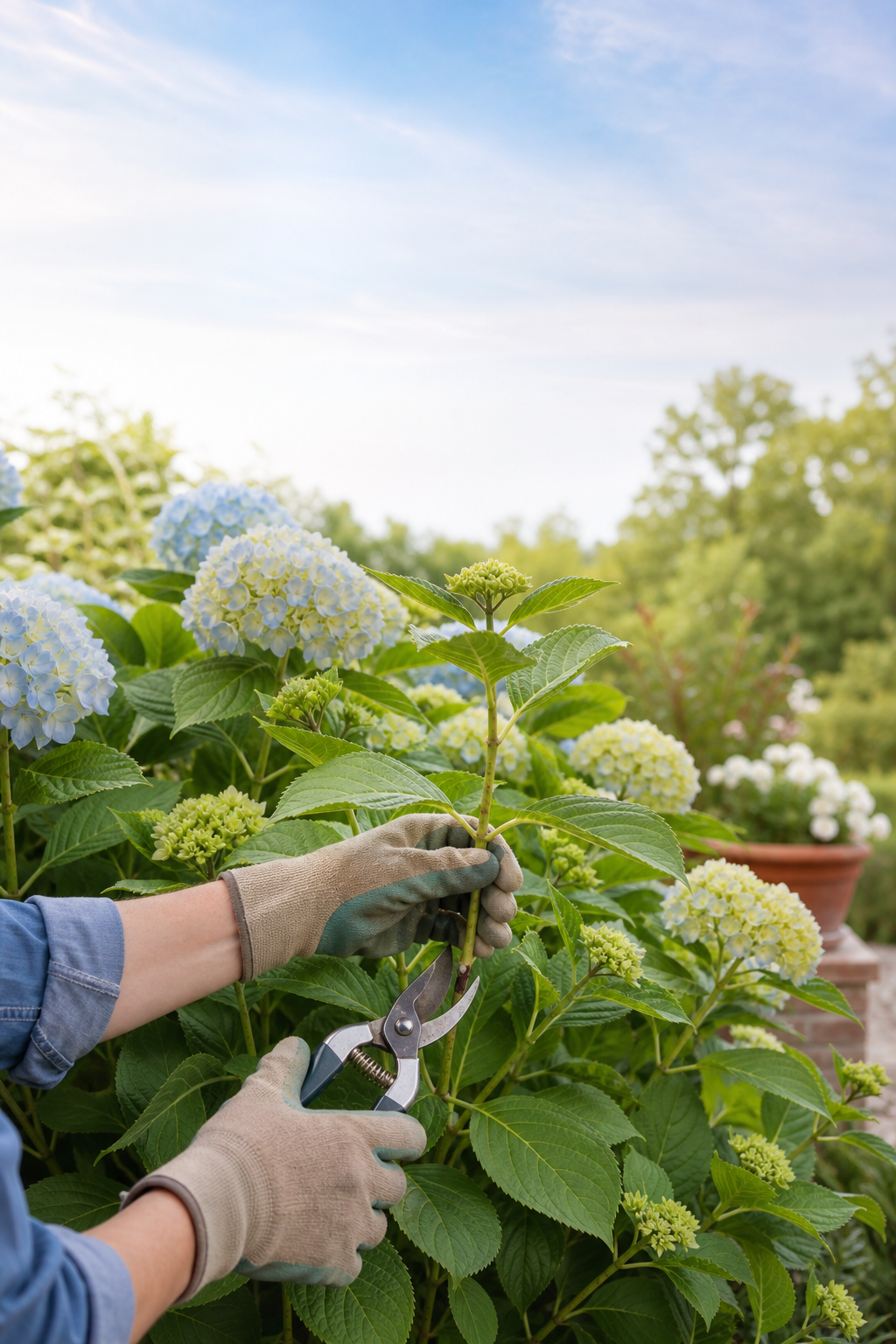
In this guide
- Find your hydrangea in this quick guide
- Identify the plant before choosing a date
- How to identify your hydrangea
- Prune in this safe order
- How to prune old-wood hydrangeas
- How to prune new-wood hydrangeas
- If it reblooms—or you do not know the type
- Deadheading is not the same as resizing
- If your hydrangea does not bloom
- Eight mistakes that can cost flowers
- Make the pruning decision in two minutes
- Frequently asked questions
- Continue planning your garden
- Sources
Before you act
Identify before pruning
- Photograph it in flower: Note when it blooms, where the buds sit, and which stems are dead or damaged.
- Wait if you do not know the type: Remove only wood that is clearly dead, damaged, or weak.
- Step back before another cut: Give yourself time to check the shape and confirm the plant type.
Quick answer: identify the hydrangea before pruning. Panicle and smooth hydrangeas usually bloom on new wood and can be pruned in late winter or early spring. Bigleaf, mountain, oakleaf, and climbing hydrangeas commonly bloom on old wood and should be pruned, if needed, soon after flowering. Some reblooming cultivars flower on both.
Before you prune, answer one question: does this hydrangea make flower buds on old stems or new growth? Cutting at the wrong time can leave you with a healthy green shrub but few flowers. If you cannot identify the plant, make only essential cuts and wait.
Pause before pruning: This is general garden guidance, not a diagnosis for a specific plant. Local weather, cultivar behavior, disease, and winter damage can change the right action. Use the exact plant label and local Extension advice when available.
Find your hydrangea in this quick guide
| Plant view | Common type | Botanical name | Blooms on | Usual pruning window |
|---|---|---|---|---|
| Bigleaf (mophead or lacecap) | Hydrangea macrophylla | Usually old wood; some varieties bloom on both | After flowering, if pruning is needed | |
| Mountain | Hydrangea serrata | Usually old wood; check the exact variety | After flowering, if pruning is needed | |
| Oakleaf | Hydrangea quercifolia | Old wood | Immediately after flowering | |
| Climbing | Hydrangea anomala subsp. petiolaris | Old wood | After flowering, only when necessary | |
| Panicle | Hydrangea paniculata | New wood | Late winter or early spring | |
| Smooth | Hydrangea arborescens | New wood | Late winter or early spring |
Use the table as a starting point, then check the label for your exact variety. Some reblooming bigleaf and mountain varieties can flower on both old stems and new growth.
Identify the plant before choosing a date
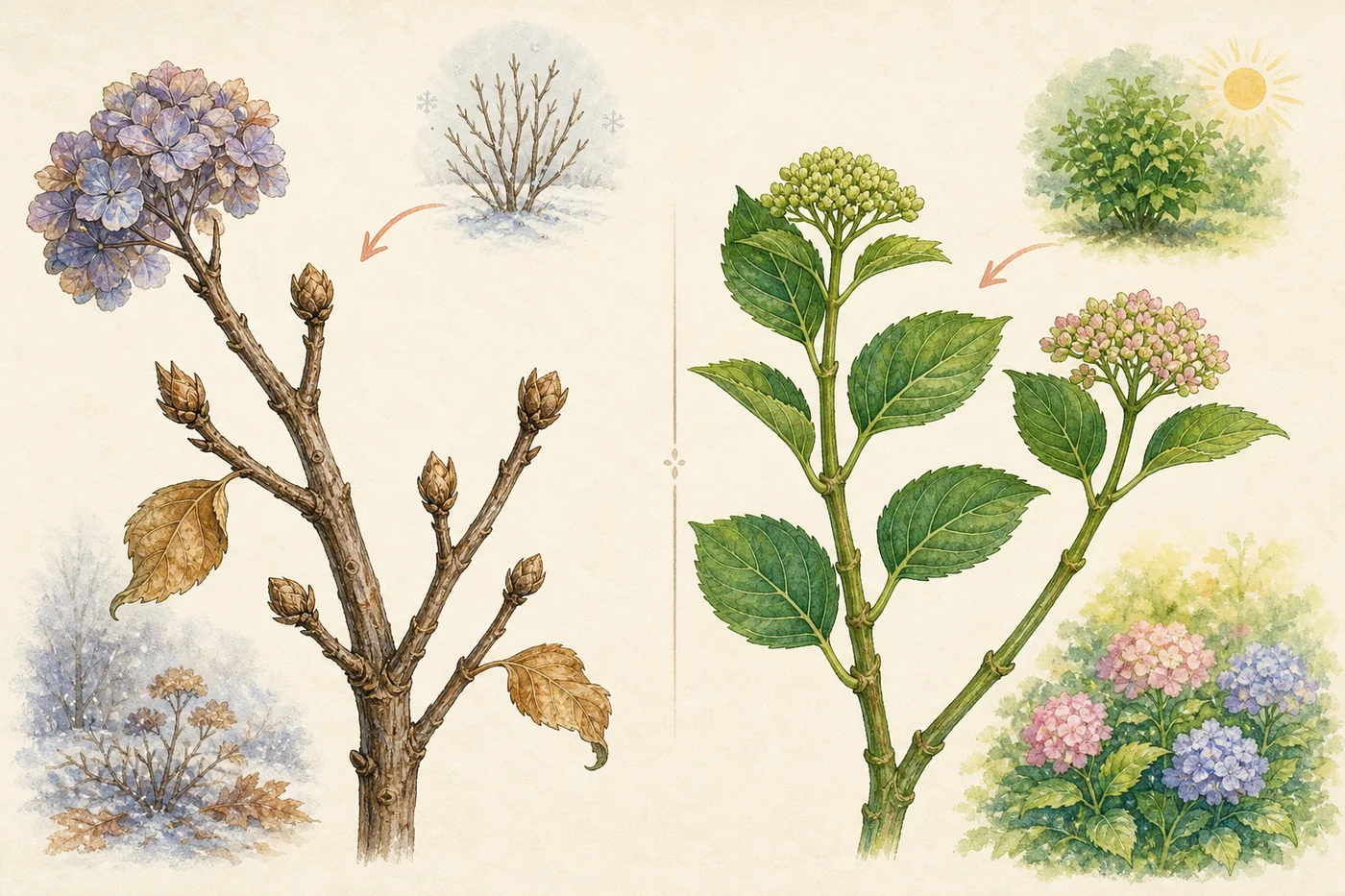
Do not begin with the calendar. Begin with the plant tag. Hydrangeas do not all form flower buds at the same time. An old-wood hydrangea carries much of next season’s flower potential on stems that grew last year. A new-wood hydrangea forms flower buds on stems produced in the coming growing season.
That difference changes the safe pruning window. Cutting an old-wood type in autumn, winter, or early spring can remove buds before they open. Panicle and smooth hydrangeas, by contrast, can be shaped in late winter or early spring because their flowers form on the new growth that follows.
Some modern bigleaf and mountain varieties bloom on both old stems and new growth. They are a little more forgiving, but they still do not need hard pruning. The exact variety name is more reliable than flower colour or a broad shop label.
How to identify your hydrangea
Look for the original plant label, order confirmation, or nursery receipt. Search the exact variety name on a university Extension or breeder website. A broad name such as ‘blue hydrangea’ is not enough. Flower colour does not show whether it blooms on old stems or new growth.
If the label is gone, compare several clues: the leaves, flower shape, full-grown form, and usual flowering time. Oak-shaped leaves strongly suggest an oakleaf hydrangea. Upright cone-shaped flowers often point to a panicle type. Rounded flower heads may point to a bigleaf type, but the exact variety can still change the pruning advice.
When identification is uncertain, take clear photos of the whole plant, leaves, stems, and flowers and ask a reputable nursery or local Extension service. The safest temporary choice is to remove only confirmed dead, damaged, or diseased wood and postpone size reduction.
Prune in this safe order
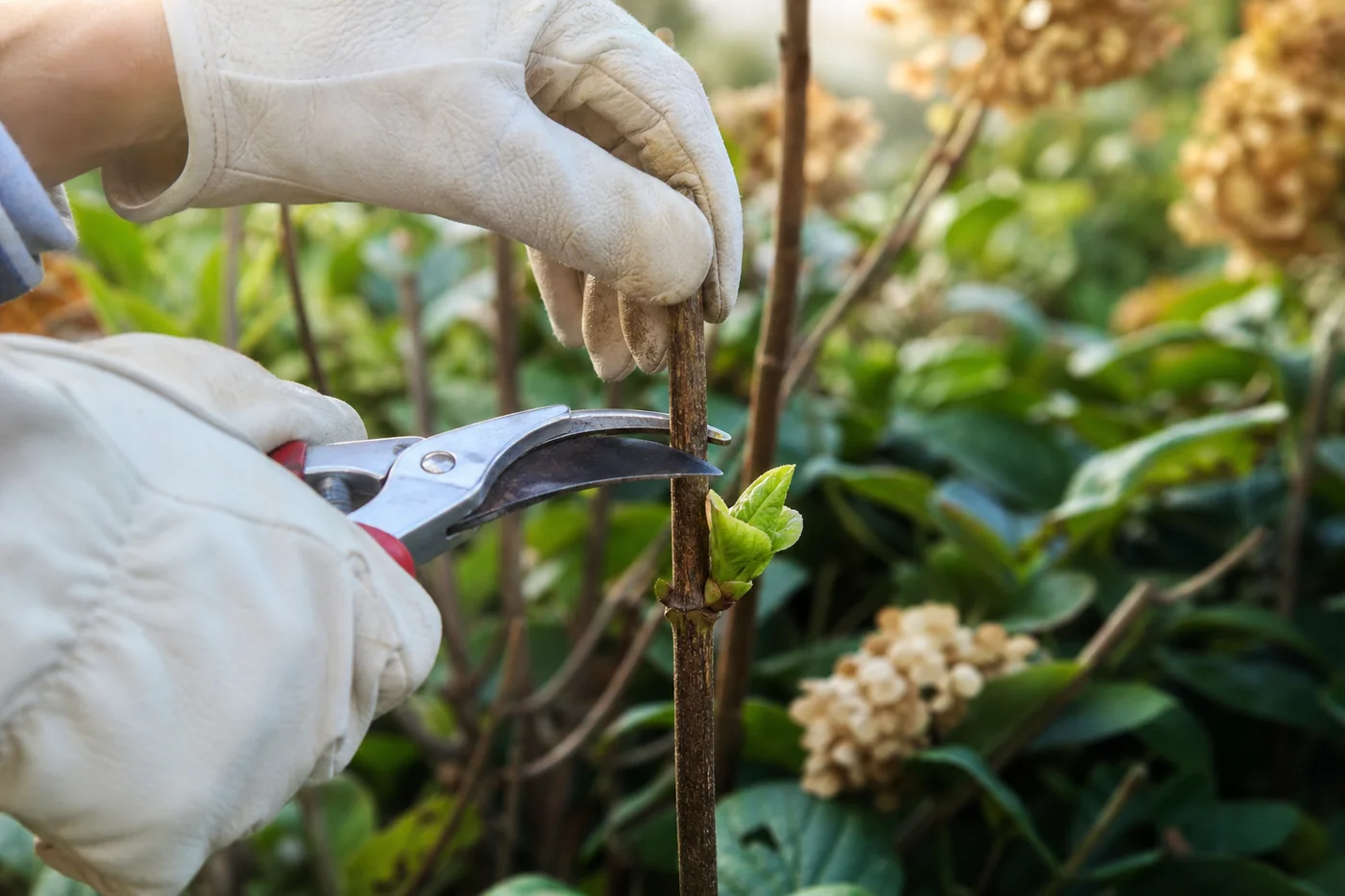
Choose a dry working period and wear gloves and eye protection. Use sharp bypass pruners for small stems and loppers or a pruning saw only when the branch size requires them. Clean away sap and plant debris. Disinfect tools before use and after working on a plant that may be diseased so tools do not carry pathogens to another shrub.
Step back and name the reason for every cut. Start with dead, broken, rubbing, or obviously diseased stems. Then consider a small number of older stems if the center is crowded. A thinning cut removes a stem at its origin and usually preserves the shrub’s natural outline better than shearing every stem to the same height.
For a heading cut on a suitable new-wood type, cut just above a healthy outward-facing bud. Do not leave a long stub, and do not cut into the bud. Stop frequently and view the whole plant. A slightly uneven natural framework is usually healthier and more attractive than a tight dome.
Remove less than you first think. Hydrangeas do not need pruning every year, and pruning cannot fix a shrub that is too large for its position. If you need severe cuts every year to keep it away from a path or window, move it or replace it with a smaller variety.
How to prune old-wood hydrangeas
Bigleaf, mountain, oakleaf, and climbing hydrangeas commonly flower on old wood. If they need shaping, work soon after flowering rather than waiting for the dormant season. This gives the plant time to produce and mature the stems that can carry the following year’s flower buds.
Begin by removing dead wood and any stem that is broken or rubbing. For an established multi-stem shrub that has become congested, remove a limited number of the oldest stems at the base. Keep healthy younger stems because they form the future framework. Avoid shortening every stem simply to make the plant look even.
Do not use one fixed date for every climate. Flowering and bud growth change with the hydrangea type, exact variety, and local weather. Check the variety instructions when flowering ends. If the safe window has passed, waiting until next year is often better than making a large late cut.
How to prune new-wood hydrangeas
Panicle and smooth hydrangeas form flowers on the current season’s growth, so late winter or early spring is the usual pruning window. Start by removing dead and damaged stems. Then thin crowded growth and shorten selected stems only enough to create a strong, open framework.
Some mature smooth and panicle hydrangeas can recover from hard pruning, but they do not all need it. Leaving several strong stems can support heavy flower heads. Give young plants time to settle in before making severe cuts.
For panicle hydrangeas trained as small trees, preserve the trunk and intended branch structure. Remove shoots that undermine that form rather than treating the plant like a ground-level shrub. Large, high, damaged, or structurally important branches are a reason to use a qualified professional.
If it reblooms or you do not know the type
A reblooming bigleaf variety can flower on both older stems and new growth. You are less likely to lose every flower, but hard pruning may still delay or reduce the first display. Keep as many healthy stems as you can and follow the instructions for the exact variety.
For an unknown plant, observe it for one full flowering cycle. Record when flowers appear and which stems carry them. Photograph leaves and flower heads and compare them with reliable identification resources. During that observation year, limit work to dead, damaged, rubbing, or diseased material.
Do not assume a shrub is dead because its outer stems look bare early in spring. Cold-climate hydrangeas can leaf out slowly, and winter injury may be uneven. Wait for growth to show where practical, then prune damaged stems back to live tissue.
Deadheading is not the same as resizing
Deadheading removes a spent flower head; structural pruning removes stems. You can leave dried flower heads for winter interest or remove them carefully. On an old-wood type, follow the stem down only to the first healthy pair of buds and avoid turning a cosmetic trim into a major cut.
A hydrangea does not need deadheading to survive, and removing old flowers does not guarantee more blooms. Treat it as an appearance choice. If you cannot see healthy buds clearly, leave the flower head until the plant begins to wake.
If your hydrangea does not bloom
Pruning is only one possible cause. Winter cold, late freezes, animals, or an exposed position can damage buds on old stems. Too little light can reduce flowers. Too much high-nitrogen fertilizer can produce leaves instead of blooms. A newly planted shrub may also be putting its energy into root growth.
Do not reach for fertilizer first. Confirm the hydrangea type and exact variety, then check when it was last pruned. Look for stems damaged over winter. Compare the actual light with the plant’s needs, and think back over watering, drainage, and fertilizer use. One year without flowers does not mean the plant needs a hard cut.
If leaves or stems show unusual spots, cankers, distortion, or widespread dieback, avoid moving from that plant to healthy shrubs with the same uncleaned tools. Photograph the symptoms and seek a local diagnosis before making a major treatment decision.
Eight mistakes that can cost flowers
- Pruning every hydrangea in late winter without identifying it.
- Using flower color alone to decide the species or pruning group.
- Shearing the shrub into a tight ball and leaving a dense twiggy surface.
- Cutting a young or stressed plant hard because a mature example tolerated it.
- Assuming a reblooming variety cannot lose flowers after severe pruning.
- Treating deadheading as permission to shorten whole stems at any time.
- Using dirty or dull tools, especially after working on a diseased plant.
- Trying to control a plant that is too large for its site through annual severe cuts.
Make the pruning decision in two minutes
- Do you know the hydrangea type and exact variety? If not, remove only stems that are clearly dead, damaged, rubbing, or diseased.
- Does it bloom on old wood? Prune only if needed, soon after flowering.
- Does it bloom on new wood? Prune in late winter or early spring, preserving a sensible framework.
- Does it bloom on old stems and new growth? Follow the variety instructions and keep healthy stems if you want the first flowers.
- Is the plant too large for the space? Move it or choose a smaller variety instead of making severe cuts every year.
Frequently asked questions
What month should I prune hydrangeas?
There is no safe month for every hydrangea. Prune panicle and smooth types in late winter or early spring. Prune old-wood types, if needed, soon after flowering. Adjust the timing for your climate and exact variety.
Can I cut my hydrangea all the way back?
Some established smooth and panicle hydrangeas tolerate hard pruning, but it is not required and may remove a useful supporting framework. Do not cut an old-wood type to the ground if you want the buds already carried on its stems.
How can I tell whether a branch is dead?
Wait for growth to show when practical. Dead stems are commonly dry and brittle, while living tissue remains flexible and shows healthy buds or green tissue beneath a very light scratch. When uncertain, seek local help before removing a major stem.
Should I remove brown hydrangea flowers?
You may leave them for winter interest or deadhead them. On old-wood types, cut only above the first healthy buds below the flower head and avoid shortening the whole stem.
Will pruning make my hydrangea bloom more?
Correct pruning can preserve flowering wood and improve an overcrowded shrub, but it cannot guarantee more flowers. Light, winter injury, plant age, water, and fertilizer also affect bloom.
Continue planning your garden
- Use the low-maintenance garden guide to match plant choice with a realistic care routine.
- Review beginner garden tools before choosing pruners or loppers.
- Join The Garden Edit for consent-based seasonal garden guidance.
Sources
This draft was checked against university Extension guidance on 2026-07-30:
- University of Minnesota Extension: Pruning hydrangeas for best bloom
- University of Illinois Extension: How to properly prune hydrangeas
- Penn State Extension: When to Prune Which Hydrangea Species
- University of Minnesota Extension: Clean and disinfect gardening tools and containers
Editorial note: external sources are included for evidence and reader verification. This article contains no affiliate link, product price, or paid-product promotion.